Two Kinds of People at One Lake: Day-Trippers and Salkantay Trekkers
Day-trippers from Cusco and Salkantay trekkers share the Humantay shore each morning. A guide on where each group came from and which experience fits you.
 By Carlos Mamani, Humantay Lake tour guide & high-altitude specialist
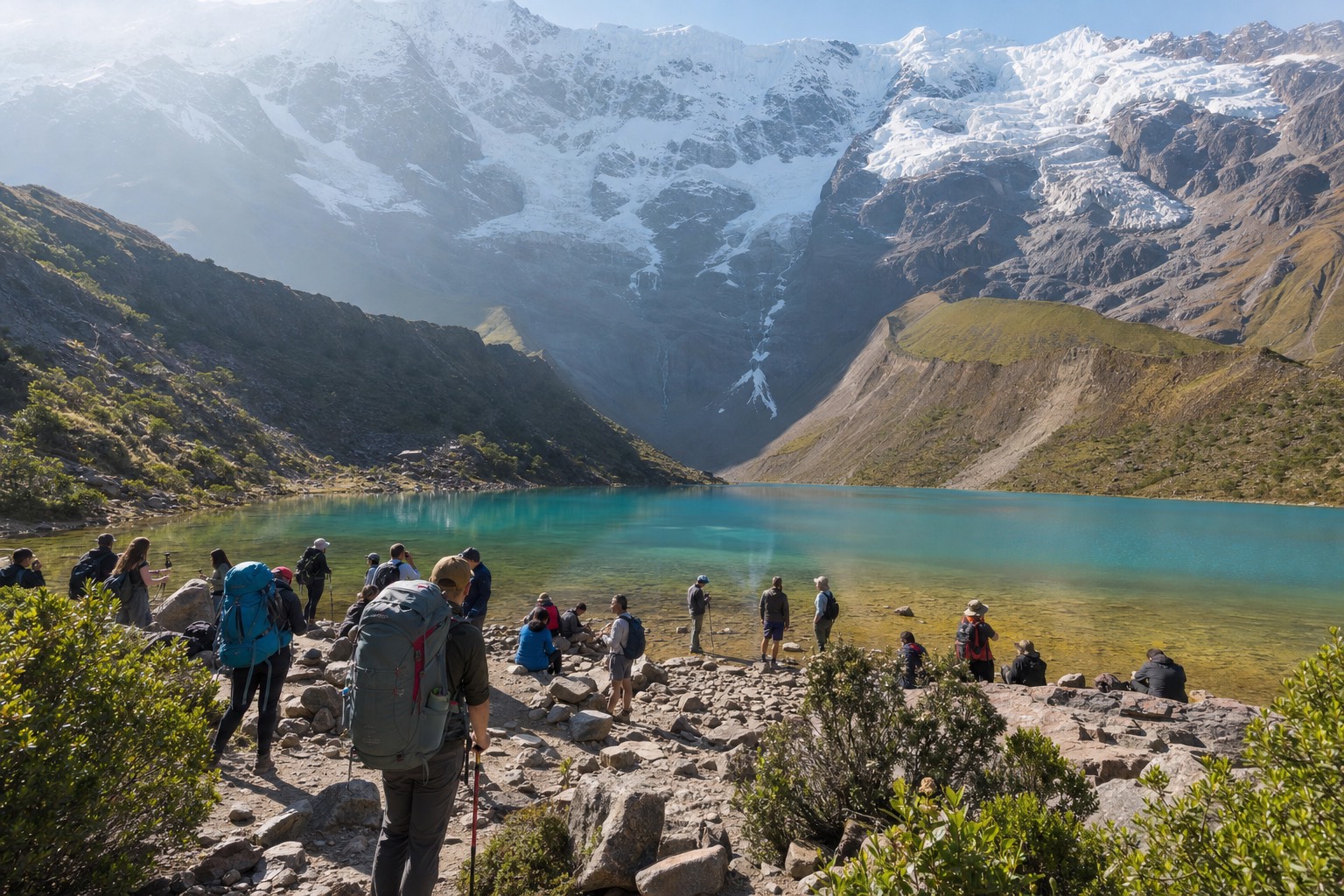
You can tell them apart from fifty metres. One crowd arrives in clean sneakers and rented ponchos, phones already out, faces somewhere between euphoria and oxygen debt. The other crowd comes up the same trail in broken-in boots with proper packs, moving at that unhurried pace people find on multi-day walks, and they look at the lake a beat longer before reaching for a camera. Same shore, same hour, same turquoise. Two completely different mornings behind them, and two completely different afternoons ahead. I have guided the first crowd for years and camped alongside the second, and the mix fascinates me every single time.
Who is actually standing on the shore at 10 AM
On a clear dry-season morning the shore holds two populations: day-trippers who left Cusco around 4 AM and will sleep in their own hotel beds tonight, and Salkantay trekkers on day one of a roughly 73 to 74 km, five-day walk to Machu Picchu. They overlap for about an hour.
The timing is not a coincidence. Day-trip vans leave Cusco between 3:30 and 4:00 AM, stop for breakfast in Mollepata, and put their groups on the Soraypampa trail by roughly 8:00 to 8:30. The trekkers slept at Soraypampa camp, at about 3,900 m, and walk up to the lake as an acclimatization side trip before or after their first big day. So between roughly 9 and 11 the two streams pour onto the same shoreline, and then, almost on a schedule, they separate forever. The day crowd heads down to a buffet lunch and a van. The trekkers head back to camp to continue toward the Salkantay pass, the 4,600 m crossing they will make beneath a 6,271 m glaciated peak.
I like arriving early enough to watch the shore fill. There is a moment, most mornings, when a day-tripper asks a trekker where they walked from, and the trekker points back down the valley and says "we camped there, tonight we cross that," and points at the white wall of Salkantay. The day-tripper's face does something complicated. Half of them look relieved. The other half look like they just found the trip they should have booked. This article is for both halves.
The altitudes behind the two crowds explain most of the difference in mood:
| Point on the route | Altitude | Whose journey it belongs to |
|---|---|---|
| Cusco | ~3,400 m | Where the day-tripper sleeps and starts |
| Soraypampa trailhead | ~3,850 m | Where the day trip begins walking |
| Soraypampa camp | ~3,900 m | The trekkers' first night |
| Humantay Lake | ~4,200 m | The shared high point of the day trip |
| Salkantay pass | ~4,600 m | The trek, on day two |
| Apu Salkantay peak | 6,271 m | Looms over both, climbed by neither |
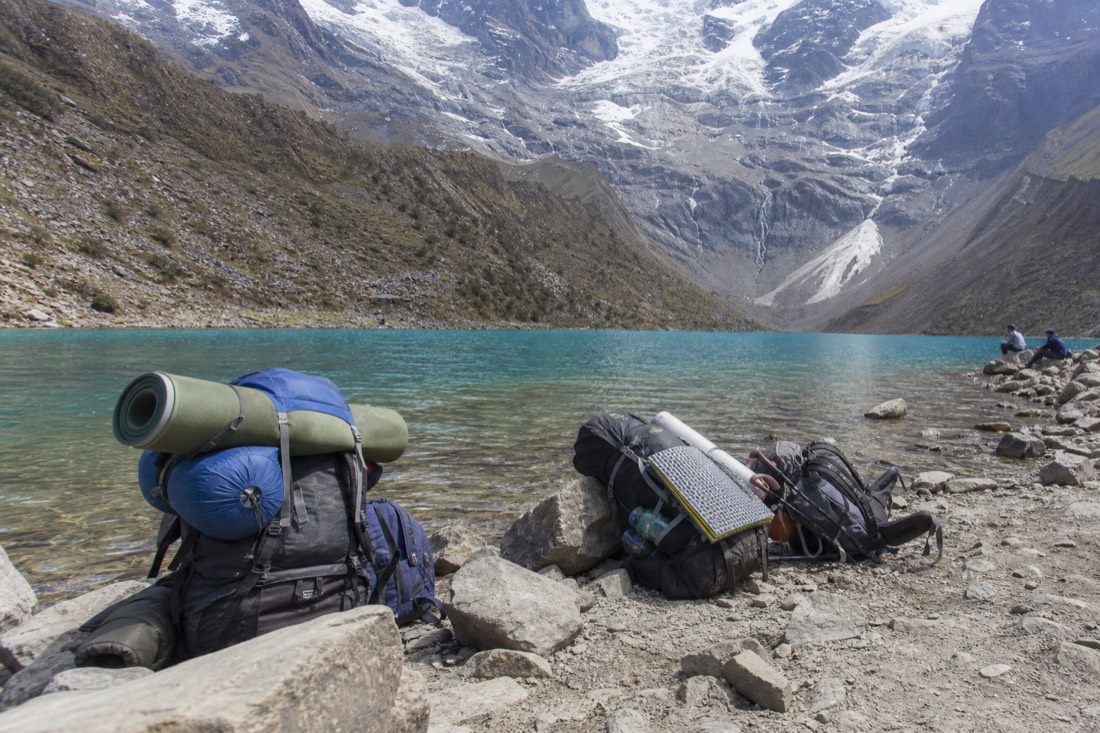
Where the trekkers came from, and where they are going
The trekkers slept at Soraypampa, the first camp of the Salkantay trek to Machu Picchu. For them Humantay Lake is a side hike on day one. Day two takes them over the Salkantay pass at around 4,600 m, and three more days of walking deliver them to Machu Picchu itself, no permit quota required.
It helps to see the lake through their eyes. For a trekker, this shore is not the destination. It is a warm-up, a first test of lungs and legs before the pass, and a spectacular one. The classic route runs about 73 to 74 km over five days and four nights: Soraypampa and the lake on day one, the high pass on day two, then a long descent through cloud forest toward the Machu Picchu district. Unlike the Inca Trail, the Salkantay route has no permit quota, which is a big part of why it has become the main alternative for people who decided late or want a wilder walk.
Set the two products next to each other and the scale difference is obvious:
| Day trip from Cusco | Salkantay trek | |
|---|---|---|
| Total length | One day, back by evening | ~73 to 74 km over 5 days, 4 nights |
| Where you sleep | Your own Cusco hotel | Camps, first night at Soraypampa (~3,900 m) |
| Highest point | The lake, ~4,200 m | Salkantay pass, ~4,600 m on day two |
| Permit needed | No | No quota either, unlike the Inca Trail |
| Meals | Hot breakfast and buffet lunch in Mollepata | Camp cooking for five days |
| Ends at | Plaza de Armas drop-off | Machu Picchu, on foot |
That context explains the trekkers' mood at the lake. They are pacing themselves. Nobody sprints the switchbacks with four days of walking ahead, and their guides actively hold them back, because the lake sits at 4,200 m and the smart ones treat it as altitude training rather than a race. They also carry a different relationship with weather: a day-tripper hopes for one clear hour, a trekker needs five workable days.
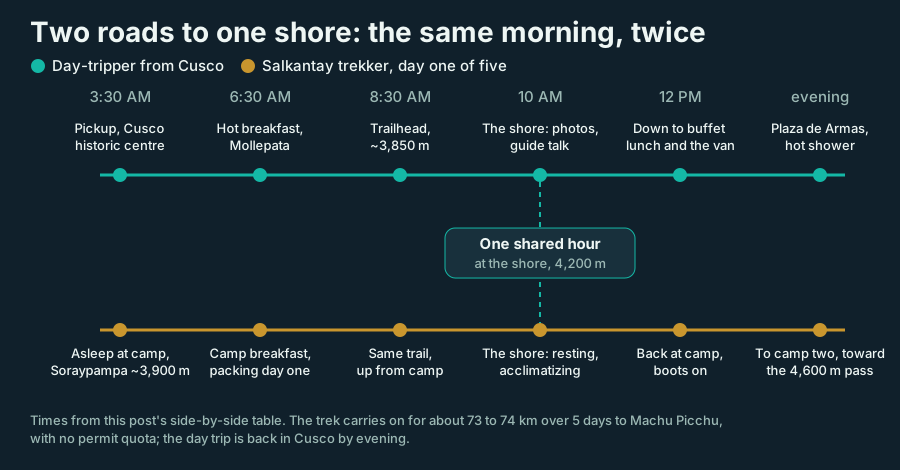
Here is the shape of the two mornings side by side:
| Time | Day-tripper | Salkantay trekker |
|---|---|---|
| 3:30 AM | Pickup in Cusco's historic centre | Asleep in a tent or dome at Soraypampa |
| 6:30 AM | Hot breakfast in Mollepata | Camp breakfast, packing for day one |
| 8:30 AM | Starting up the trail from the trailhead | Starting the same trail from camp |
| 10:00 AM | At the shore, photos, guide talk | At the shore, resting, acclimatizing |
| 12:00 PM | Descending to lunch and the van | Back at camp, boots on for the route ahead |
| Evening | Dropped off near Plaza de Armas, hot shower | Camp two, one high pass closer to Machu Picchu |
Two moods, one lake
The day crowd treats the shore as a summit: loud, celebratory, photo-first, and understandably wrecked by the climb. The trekkers treat it as a rest stop: quieter, slower, already adjusted to the altitude of their camp. Neither mood is wrong. They are just calibrated to different days.
The energy difference is real and worth naming honestly. Day-trippers have compressed an enormous experience into one long day: a 3:30 AM alarm, three hours of mountain road, then a steep climb of roughly 300 to 400 vertical metres straight off the bus, starting near 3,850 m. Of course they arrive euphoric and gasping. I wrote about that alarm-clock brutality in the 3:30 AM alarm, and the climb itself is short but genuinely steep. Their bodies came from Cusco's 3,400 m that same morning, and it shows.
The trekkers have the opposite profile. They spent yesterday walking or driving in gradually, slept high at camp, and their acclimatization curve is a full day ahead. They also carry the psychological difference of people who are not going home tonight. You see it in small behaviours: they sit down properly, they eat real food out of real bags, they take fewer photos and longer looks. There is a calm to a group that knows the lake is chapter one rather than the whole book.
Watching the two groups meet cured me of ranking them. The day-tripper who cried at her first sight of glacier ice had exactly as real a morning as the trekker quietly eating cheese with his boots off. The mountain does not grade you on itinerary.
Which experience actually suits you
Choose the day trip if you have one spare day, a Cusco hotel you like, or any doubt about your fitness at altitude. Choose the trek if you have five days, solid conditioning, and you want Machu Picchu earned on foot. The day trip is not a small trek. They are different products.
I refuse to pretend the day trip is a miniature Salkantay, because it is not, and pretending helps nobody. The trek is a committed, five-day physical undertaking with camping, a 4,600 m pass, and cumulative fatigue. The day trip is one hard climb wrapped in van transfers and two cooked meals, home by evening. What they share is this shore and this water, and the shore is genuinely the scenic peak of the trek's first day, so the day-tripper is not getting a consolation prize. The full head-to-head lives in day trip versus the Salkantay trek, but the decision usually comes down to a few honest questions:
| Your situation | Better fit | Why |
|---|---|---|
| One free day in a Cusco itinerary | Day trip | The lake fits in a day; the trek does not |
| Five-plus free days, good fitness | Trek | The pass and the arrival on foot are unmatched |
| Unsure how you handle altitude | Day trip | You sleep low in Cusco, with oxygen on the bus |
| Machu Picchu is the true goal | Trek | The route delivers you there walking |
| Travelling with mixed fitness levels | Day trip | Horses at Soraypampa cover most of the climb |
| You hate camping more than you love views | Day trip | Nobody enjoys the pass from inside a wet tent |
One practical note from the compliance file rather than romance: the horse option at Soraypampa runs around 80 soles one way, paid on site, and the horses stop 15 to 20 minutes short of the shore, so even assisted visitors finish the last stretch on foot. I unpack that whole choice in the horse decision at Soraypampa.
If the day trip is your pick
Book a small-group departure with both meals and early pickup, then spend your saved energy on acclimatizing properly beforehand. Two easy days in Cusco first, per standard altitude guidance, will do more for your morning at the shore than any gear purchase.
If the table above pointed you at the day version, the one this site features is the small-group departure with hot breakfast and buffet lunch in Mollepata: per the GetYourGuide listing it carries a 4.8 rating across 3,809 reviews, runs with bilingual guides, includes first aid and an emergency oxygen bottle, and cancels free up to 24 hours. When you are ready, book the small-group day trip with both meals included and check live availability and prices on GetYourGuide. Then protect the investment: give yourself at least two quiet days at Cusco's altitude first, hydrate, and skip the pisco the night before. The CDC's high-elevation guidance says what every guide up here repeats for free: altitude rewards patience and punishes schedules.
Last month I watched a day-tripper and a trekker swap contact details at the shore. She wanted his packing list for next year's trek. He wanted her hotel recommendation for a real bed after Machu Picchu. Both of them got the lake right, in other words. They just got it in a different order.