Humantay Day Trip or the Salkantay Trek: Which Way to See the Lake?
Both routes stand on the same shore. One gets you back to Cusco for dinner, the other keeps walking to Machu Picchu.
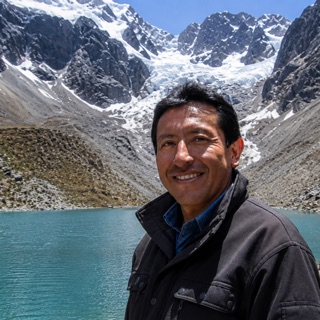 Written with Carlos Mamani, Humantay Lake tour guide & high-altitude specialist
Short answer
Take the day trip if you have one spare day, average fitness, or Machu Picchu already booked by train. Choose the Salkantay trek if you have four to five days, strong legs, and want to walk to Machu Picchu. Both reach the same lake; the trek visits it on day one.
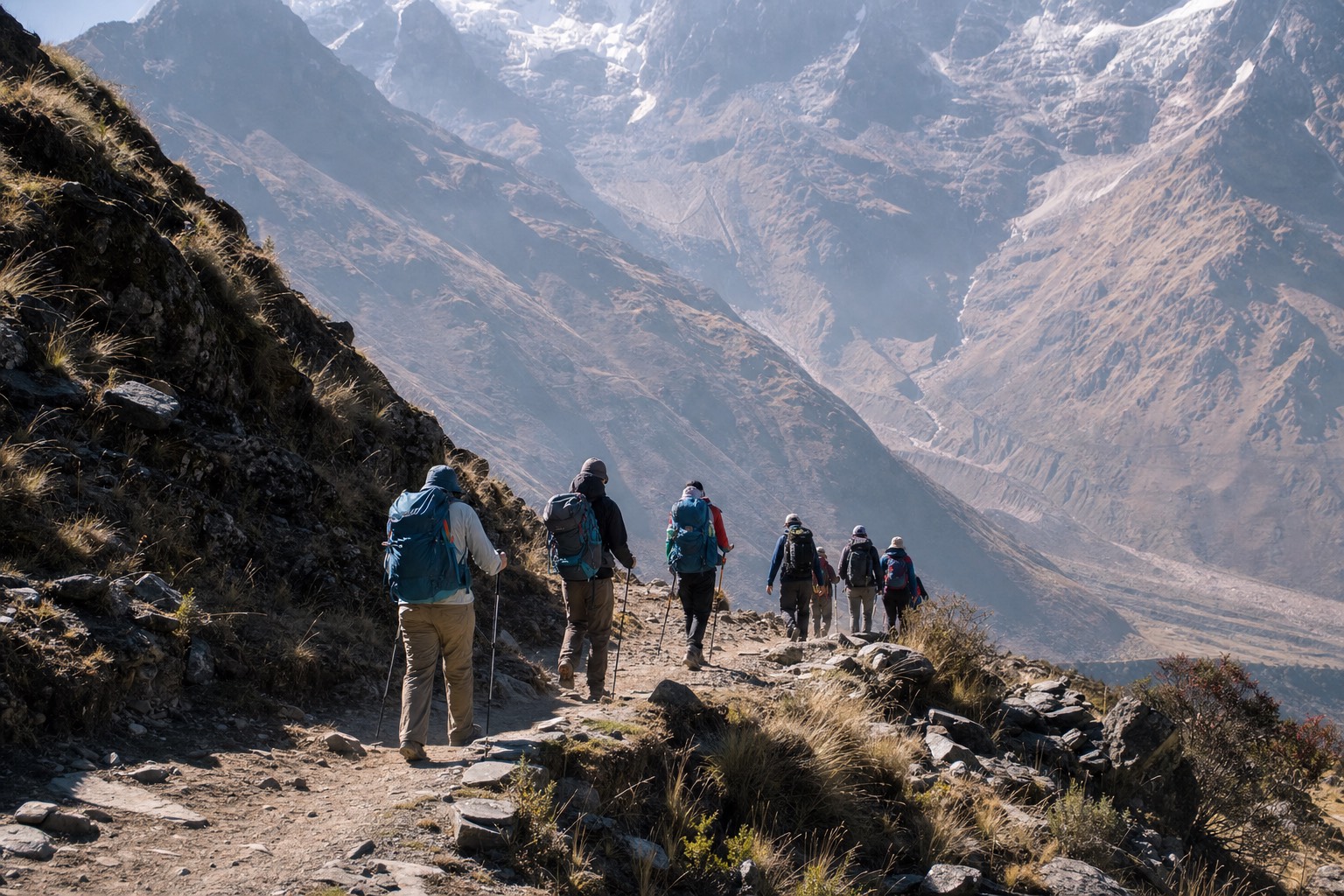
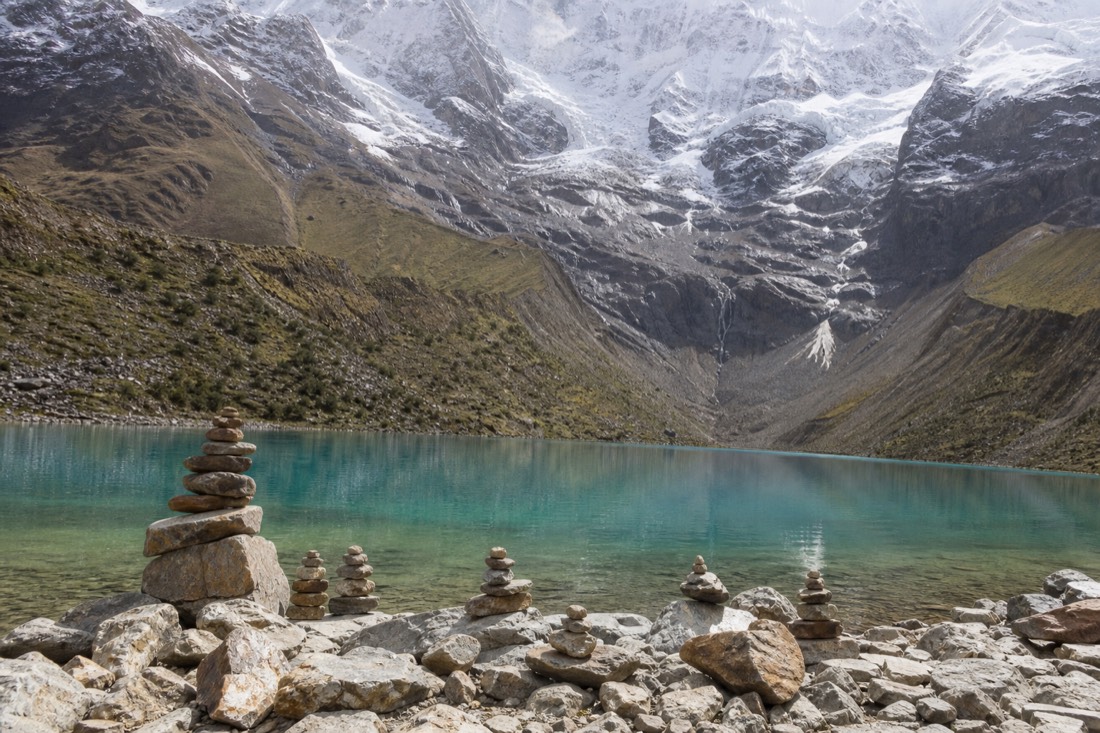
Around ten in the morning the two tribes meet at the shore. Day hikers arrive light, a small pack and a rented walking stick, faces still creased from the 3:30 AM pickup. Trekkers come up from the Soraypampa camp with mud on their gaiters and four more days ahead of them. They photograph the same turquoise water under the same glacier. Then one group walks back down to a buffet lunch and a van to Cusco, and the other turns toward a 4,600 metre pass. I have paced day-trip groups up these switchbacks since 2022, and I have watched plenty of them stare at the trekkers with a mix of envy and relief. This guide is for deciding which of those two people you want to be.
What is the actual difference between the day trip and the trek?
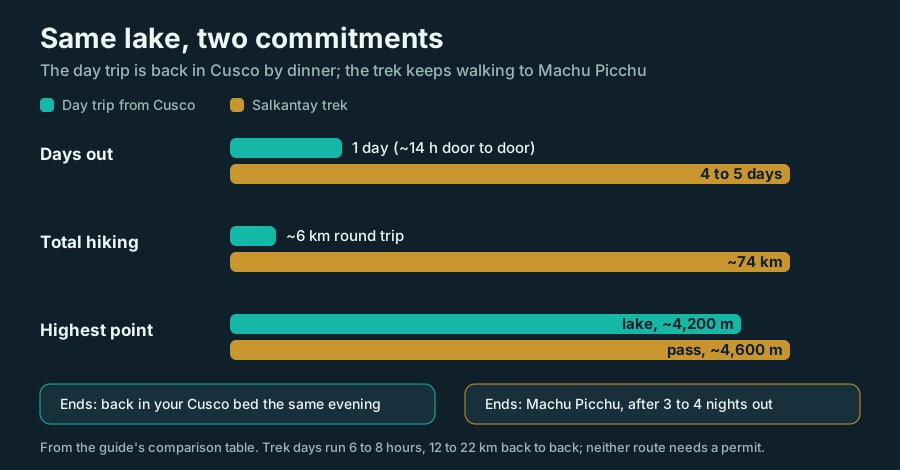
The day trip is a single long day from Cusco: drive out, hike about 3 km up to the lake, lunch, drive home. The Salkantay trek is a 4 to 5 day, roughly 74 km walk to Machu Picchu that visits Humantay Lake as a side hike on its first afternoon, then continues over the high pass.
The lake itself does not change. Either way you stand at about 4,200 m below Humantay peak, and the climb from the Soraypampa trailhead is the same steep, rocky hour and a half or so. What changes is everything around that hour and a half.
The day trip compresses the experience into roughly fourteen hours door to door. You sleep in your Cusco bed on both ends, someone else handles breakfast, lunch, transport and the entrance fee, and the only hiking is the lake climb itself. I break down that climb honestly in the hike difficulty guide, because short does not mean easy at this altitude.
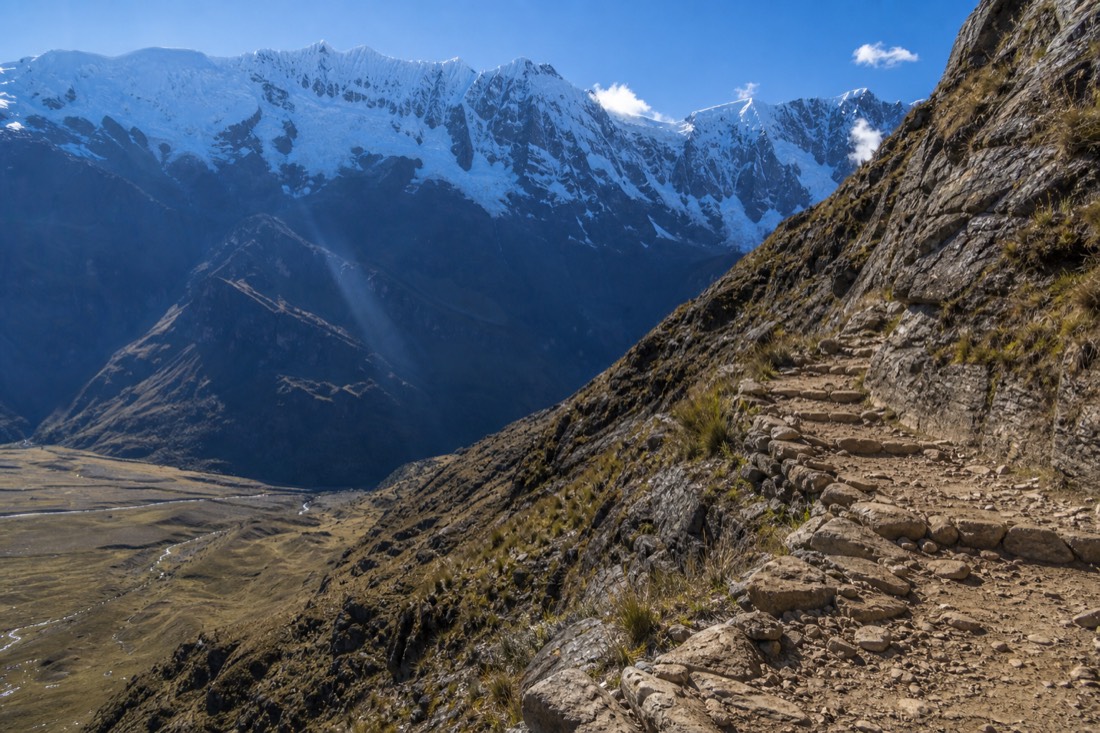
The trek is a commitment of a different species. The classic route runs four or five days from Challacancha or Soraypampa across the flank of Salkantay, the 6,271 m peak that dominates this whole corner of the Andes, down through cloud forest and coffee country to Aguas Calientes, and finally up to Machu Picchu. You camp or sleep in trailside lodges, carry at least a daypack every day, and hike six to eight hours daily. Humantay Lake is the warm-up, not the destination.
| Aspect | Day trip from Cusco | Salkantay trek |
|---|---|---|
| Time commitment | One day, roughly 14 hours door to door | 4 to 5 days, 3 to 4 nights |
| Total hiking | ~6 km round trip at the lake | ~74 km over the full route |
| Highest point | The lake at ~4,200 m | Salkantay pass at ~4,600 m |
| Nights out | None, you sleep in Cusco | Camps or trail lodges every night |
| Ends at | Back in Cusco the same evening | Machu Picchu |
| Luggage | Small daypack only | Duffel plus daypack, mule-supported |
How does the Salkantay trek fit Humantay Lake into its route?
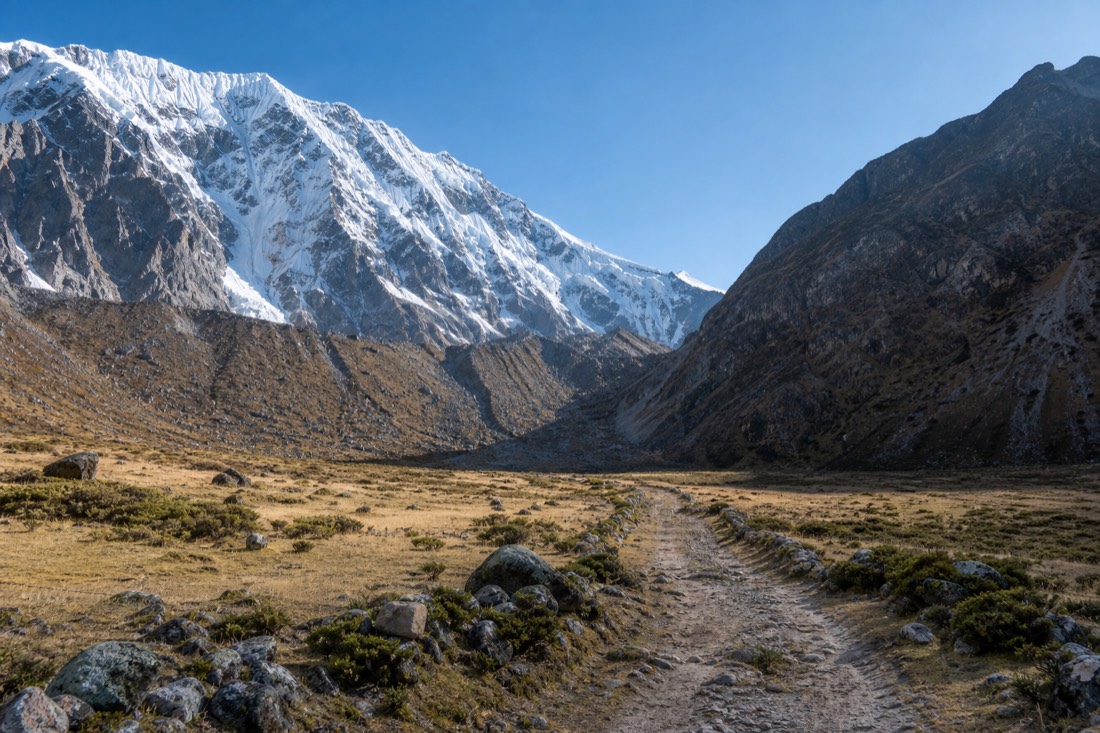
Trekkers see the lake on day one. The classic itinerary starts near Challacancha, walks a gentle canal path to Soraypampa, drops packs at camp, then climbs to Humantay Lake in the afternoon before sleeping at about 3,900 m. The following morning the trek leaves the lake behind and crosses the Salkantay pass.
This matters for two reasons. First, trekkers usually reach the shore after midday, when cloud has often rolled onto the glacier and the wind has picked up. Day-trip groups, for all the pain of the alarm clock, generally arrive in the calmer late-morning window. I have seen both versions of the lake many times, and the morning one wins more often than not.
Second, day one is the trek's acclimatization test. Anyone who struggles badly on the lake climb still has the 4,600 m pass waiting the next morning, which is a serious conversation to have with your guide at camp. On the day trip, the lake is the whole test, and the van is waiting below if the altitude wins. Either way, arriving already acclimatized changes everything, and I explain the timing in the acclimatization guide.
| Trek day | Stage | What it involves |
|---|---|---|
| Day 1 | Challacancha to Soraypampa, plus the lake | Gentle approach walk, camp, then the steep side hike to Humantay Lake |
| Day 2 | Soraypampa over the Salkantay pass | The hard one: ~4,600 m pass, longest climbing day, then a long descent |
| Day 3 | Into the cloud forest | Warmer air, coffee farms, knees complaining about the downhill |
| Day 4 | Lucmabamba to Aguas Calientes | Jungle trail or hydroelectric walk, hot showers, a real bed |
| Day 5 | Machu Picchu | Early bus up, guided visit, train and transfer back toward Cusco |
Some operators compress this to four days. The shape stays the same: lake first, pass second, ruins last.
How do time, cost and fitness really compare?
The day trip costs a fraction of the trek and asks for one hard morning. A guided Salkantay trek runs several times the price of a day tour and asks for four or five consecutive hiking days of six to eight hours, with a 4,600 m pass on day two. Neither route needs a government permit.
I will not quote trek prices here because they swing widely with group size, lodge level and season. The honest framing is proportion: expect a guided trek to cost several times what you would pay for the day tour, before you add gear rental, tips for a larger crew, and the Machu Picchu entry and train logistics at the far end. The day trip's live price sits on the operator's GetYourGuide listing, and what it includes is unusually complete: both meals, transport, guide, first aid and oxygen, entrance fee handling.
Fitness is the bigger filter. The lake climb suits any reasonably mobile person who has acclimatized properly and accepts being out of breath. The trek demands day-after-day endurance, comfort with camping at altitude, and legs that can take 12 to 22 km days back to back. The US CDC's high-altitude travel guidance applies doubly to the trek, since you sleep high instead of descending each night.
| Question to ask yourself | Day trip | Salkantay trek |
|---|---|---|
| Days I can spare | 1 | 4 to 5 |
| Consecutive hiking days | None, just one climb | 4 to 5, six to eight hours each |
| Sleeping altitude | Cusco, ~3,400 m | Up to ~3,900 m in tents or lodges |
| Cost in plain words | The affordable option | Several times the day-tour cost, plus extras |
| Permit needed | No | No, unlike the Inca Trail |
| Machu Picchu included | No, separate trip | Yes, it is the finale |
What does each experience feel like?
The day trip feels like a raid: brutal alarm, sunrise in the van, two intense hours on the mountain, then food and sleep. The trek feels like a journey, with the lake as its opening scene and four days of changing landscapes, camp routines and accumulating fatigue between you and Machu Picchu.
On the day trip the emotional arc is steep. You are half asleep through Limatambo, properly awake by the Mollepata breakfast stop, and fighting for breath on the switchbacks an hour later. Then the ridge line breaks and the colour hits you, and the whole 3:30 AM ordeal makes sense. By eight that evening you are eating dinner near the Plaza de Armas telling someone it was the hardest easy thing you have ever done.
The trek spreads that intensity out. Trekkers I meet at the shore on their first afternoon are usually still fresh and a little nervous about the pass. The reward structure is different: the lake is one highlight among many, and the arrival at Machu Picchu on the final morning carries the weight of every kilometre behind it. People who walk in tell me the ruins feel earned in a way no train can match. They are right, and it costs them four days of sore legs to be right.
There is also a middle path worth knowing about. Plenty of visitors do the day trip early in their Cusco stay, then reach Machu Picchu by train later the same week. You get the lake in good morning light and the ruins without the camping. I lay out exactly how that combination works in the Machu Picchu combo guide.
The mistakes I watch travellers make choosing between them
The commonest error is choosing the trek for the scenery and forgetting it means sleeping high for four nights with a 4,600 m pass on the morning of day two. The second is booking the day trip without acclimatizing, then blaming the tour when the altitude, not the format, was the real problem.
I have paced day-trip groups up these switchbacks since 2022, and I guided across the wider region from 2020, so I have heard both regrets up close. Trek regret tends to sound the same. Someone picked five days because the photographs were beautiful, then learned on the Salkantay pass that beautiful and comfortable are different words. That pass sits near 4,600 m, higher than the lake itself, and it arrives when your legs are already a full day tired. A person who would have loved the lake as one hard morning ends up meeting it as the bottom rung of a much taller ladder.
Day-trip regret is quieter, and it is nearly always self-inflicted. It comes from travellers who fly into Cusco and book the lake for the very next morning, skipping the two settling days I ask every group to take. They labour on the climb, decide the hike beat them, and never notice that the real culprit was the calendar. The trail did not change. Their preparation did, and I walk through the timing properly in the acclimatization guide.
There is a third, subtler mistake: assuming the trek is the only honest way to earn the lake. It is not. The day trip stands on the same shore, under the same glacier, and on a calm morning it hands you the same jolt of colour. What you trade away is the walked-in arrival at Machu Picchu, not the lake. Be honest about which of those two things pulled you here, and the decision tends to make itself.
A fourth trap is quieter and more emotional: choosing based on what will sound better afterward. The trek makes the bigger story, and I have watched people book five days chasing the version of themselves who finished it rather than the one who actually has to walk it. That is a fine reason when the legs and the spare days are genuinely there. It is a miserable one when they are not, because the mountain does not grade on ambition, and day two of a trek is a long place to regret a booking.
When someone is still wavering at the Mollepata breakfast stop, I run their situation through a simple scorecard rather than sell them either option. Read down the left column, and whichever side collects your honest yeses is your answer.
| If this is your reality | The trek fits when | The day trip fits when |
|---|---|---|
| Spare days | You hold five flexible ones | You have one, or a packed week |
| Hill fitness | You already hike multi-day routes | You are ready for one hard morning, not four |
| Machu Picchu | Walking in is the whole point | You already hold a train ticket |
| Sleeping at altitude | A tent near 3,900 m sounds fine | You want your Cusco bed both nights |
| Budget | You can absorb several times the day-tour cost | Value matters and the extras add up |
Notice the scorecard has no row for beauty, and that is deliberate. Both routes deliver the same lake, so the view is a constant rather than a variable. What actually differs is time, money, sleep and the shape of your arrival at Machu Picchu. Weigh those honestly and let the postcard stay out of the argument, because it favours neither side.
Which route actually suits your kind of traveller?
Match the route to your body and your calendar, not to the postcard. The day trip suits short stays, average fitness, tired knees and anyone whose Machu Picchu is already booked by train. The trek suits travellers with five open days, real multi-day stamina, and a strong pull toward reaching the ruins on foot.
Most people already know which tribe they belong to; they just want permission to say it out loud. The short-stay visitor with four days in Cusco does not have a trek-shaped hole in the schedule, and forcing one in usually means dropping the Sacred Valley or Rainbow Mountain to pay for it. For that traveller the day trip is not the compromise. It is the smart use of a single spare day, and it leaves the rest of the week intact.
Families and mixed-fitness groups are the other clear case. The lake climb bends to a slow pace, and the horse option at Soraypampa covers most of the ascent for about 80 soles, paid on site, though the animals stop 15 to 20 minutes short of the water. A four-day trek offers no such escape hatch once you are over the pass. I lay out the honest trade-offs of riding in the horse decision guide.
So before you book, sort yourself honestly by type. The matrix below is the same one I carry in my head when a group asks which they should have chosen.
| Traveller | Day trip | Salkantay trek |
|---|---|---|
| Short-stay city visitor | The obvious fit | Rarely enough days |
| Family with mixed fitness | Works, with the horse option | Too demanding for most |
| Seasoned multi-day hiker | Can feel too brief | The natural choice |
| Time-rich, walk-in dreamer | Leaves the itch unscratched | Exactly this |
| Traveller holding a train ticket | Pairs perfectly | Doubles the same arrival |
The trek earns its keep for a narrow person: someone who hikes at home, sleeps happily in a cold tent, and feels the arrival at Machu Picchu is only real if it was walked. For that traveller a single morning can feel thin where they wanted a week. The kit each route demands tells the same story from another angle, so treat the list below as planning guidance rather than a fixed rule, since operators vary and seasons change what you actually need.
| What you carry | Day trip | Salkantay trek |
|---|---|---|
| Bag | Small daypack, 15 to 20 L | Duffel carried by mule, plus a daypack |
| Sleeping kit | None, a hotel bed in Cusco | Sleeping bag and liner for nights near 3,900 m |
| Layers | One warm layer and a rain shell | A full cold-weather set for the pass |
| Footwear | Broken-in hiking shoes | Sturdier boots and spare socks for wet days |
| Water | 1.5 to 2 L for the morning | 2 to 3 L daily, with refill discipline |
None of this is a verdict on character. I have guided marathon runners who chose the day trip because their week was already full, and cautious first-time hikers who walked the entire Salkantay route and glowed for days afterward. The route is a tool, not a test of worth. Pick the one that fits the trip you actually booked, give the altitude its due respect either way, and the lake rewards you the same when you reach the shore.
Which one should you actually choose?
Choose the trek if walking into Machu Picchu is the point of your whole trip and you have the days and the legs. Choose the day trip if your time is short, your fitness is average, your knees are opinionated, or your Machu Picchu plans already involve a train.
After four seasons of watching both tribes at the shore, my honest sorting rule is simple. The trek is the right answer for a specific person: someone with five flexible days, genuine hill fitness, and a strong pull toward the walked-in arrival. If you hesitated on any of those three, you would probably spend day two of the trek wishing you were on the van.
For everyone else the day trip is the better tool. It delivers the identical lake, in better light, for a fraction of the money, and leaves your remaining Cusco days free for the Sacred Valley, Rainbow Mountain or the train to Machu Picchu. The version I point people to is the one this site features: small group, hot breakfast and buffet lunch in Mollepata, first aid and emergency oxygen on board, free cancellation to 24 hours. When you are ready, book the Humantay Lake day trip with both meals included and check live availability and prices on GetYourGuide.
Whichever you pick, respect the altitude. Arrive in Cusco at least two days early, walk slowly on the switchbacks, and let the mountain set the pace. The lake does not care how you got there. It only asks that you show up acclimatized enough to enjoy it.