Hiking to Humantay in the Rainy Season: An Honest Account
A guide's honest account of Humantay Lake from October to April: the mud, the cloud that hides the glacier, the quiet shore, and when the wet-season gamble pays off.
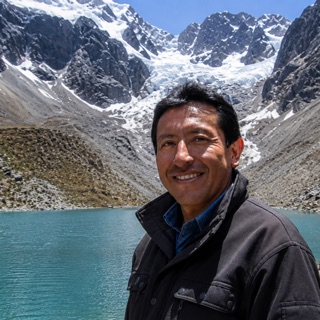 By Carlos Mamani, Humantay Lake tour guide & high-altitude specialist
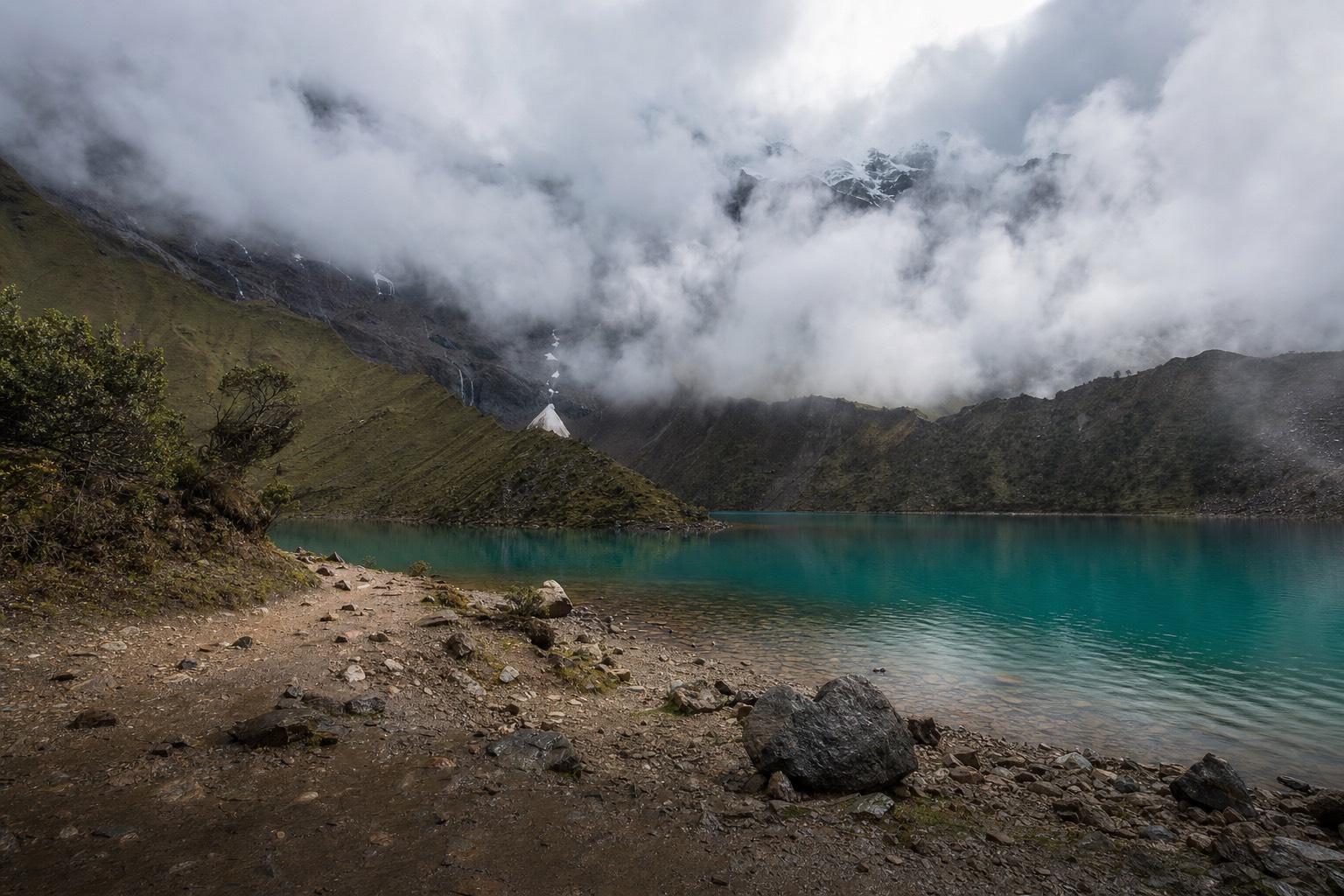
February, two seasons ago. I was standing at the shore with a group of eight, all of us dripping, and the lake was there but the mountain was not. A ceiling of cloud sat maybe forty meters above the water, flat and grey as wet slate. A woman from Portugal asked me where the glacier was and I pointed straight into the murk. Then, over about ten minutes, the ceiling tore open, the ice wall appeared with fresh snow on it, and eight people made a sound I have never heard a dry-season group make. That is the rainy season at Humantay. It takes, and occasionally it gives you something the postcards do not have.
I have guided this trail through several wet seasons now, and I want to give you the version without marketing gloss: what the months from October to April actually do to the trail, the view, and the odds.
What the wet months do to the trail
From October to April the trail turns to churned mud on the lower meadow, slick rock on the steep middle, and loose wet scree near the top. It is the same 3 km climb with roughly 300 to 470 meters of gain, but it demands real footwear and about 20 extra minutes of care. Tours run year-round; there is no seasonal closure.
The lower section out of Soraypampa suffers most. Hundreds of boots and dozens of horses work the meadow into a brown paste, and you learn to read the trail edges where the grass still holds. The steep middle third is rockier, which drains better but turns the smooth stones greasy. Coming down is where people fall; almost never going up.
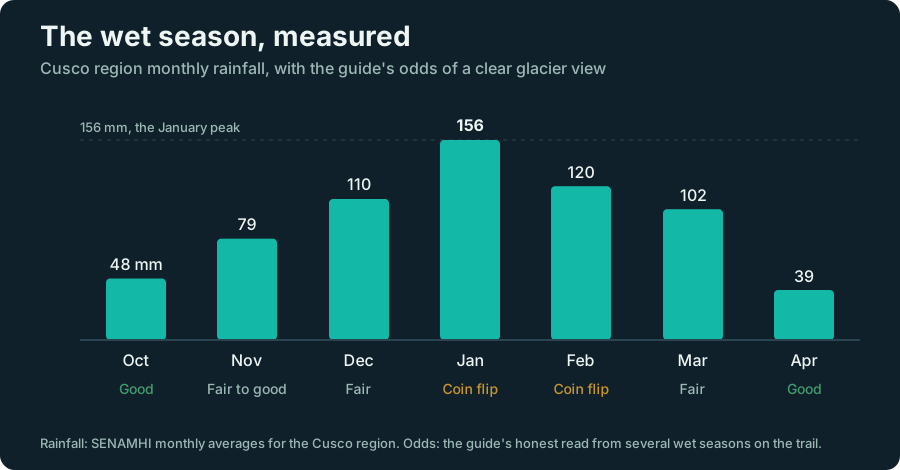
The rain itself has a rhythm you can plan around. Mornings are frequently dry or merely damp, with showers building after midday, which is one more argument for the pre-dawn start I described in the 3:30 AM alarm post. Cusco's own weather service data shows the gradient clearly: October is a mild opening act at around 48 mm of rain for the month, and January is the peak of the storm at more than three times that.
| Month | Rain (Cusco region, monthly avg) | Trail character | My honest odds of a clear glacier view |
|---|---|---|---|
| October | ~48 mm | Firm, first mud patches | Good |
| November | ~79 mm | Softening, showers most afternoons | Fair to good |
| December | ~110 mm | Muddy meadow, slick rock | Fair |
| January | ~156 mm | The full mud experience | Coin flip |
| February | ~120 mm | Wet, quietest month of all | Coin flip |
| March | ~102 mm | Still wet, slowly draining | Fair |
| April | ~39 mm | Drying fast, green and fresh | Good |
Those rainfall figures come from Peru's national weather service, SENAMHI, and they match what my boots report from the ground.
The cloud, and what it does to the famous view
Cloud is the real gamble, not rain. In the wet months the glacier and the peaks are often hidden when you arrive, then revealed in windows that open and close through the morning. The lake itself, being at your feet, is almost always visible. What you risk losing is the backdrop, not the water.
People fixate on getting wet. Wrong worry. A shower passes and your jacket handles it. The thing that decides whether your photos look like the ones that made you book is a cloud base that sits somewhere between the lake at 4,200 meters and the summit of Humantay above 5,470 meters, and in January and February it often does.
Here is what experience has taught me about those clouds: they move. Wet-season cloud at Humantay is rarely a solid all-day lid. It breathes, opens for five minutes, closes for twenty. Groups that eat their snack, wait forty-five minutes at the shore, and keep their cameras ready are rewarded far more often than groups that glance, shrug, and start down. I wrote about the worst-case version in the day the lake was grey, because you deserve to know that version exists too.
The color of the water actually holds up better than you would expect. Glacial rock flour does not wash away in the rain. Under flat grey light the turquoise reads deeper and moodier, closer to green jade than swimming-pool blue, and some photographers prefer it. The background on why the lake holds that color is on the Humantay Lake Wikipedia entry, and none of the chemistry takes the wet months off.
| What you came for | Dry season (May-Sep) | Rainy season (Oct-Apr) |
|---|---|---|
| Turquoise water | Bright, sun-lit | Deeper, jade-toned, still vivid |
| Glacier backdrop | Reliable | A gamble, revealed in windows |
| Crowds at the shore | Heavy | Noticeably thinner |
| Trail underfoot | Dry, dusty | Mud, slick rock |
| Landscape color | Golden, dry grass | Intensely green |
| Temperature at the lake | Cold mornings, clear | 10-15°C days, raw when wet |
Because that cloud breathes instead of sitting, patience becomes an actual technique, and it has a rough shape at the shore.
| Your window at the shore | Cloud behaviour to expect | What to do |
|---|---|---|
| The moment you arrive | Often a grey ceiling on the glacier | Shoot the lake and foreground now; the water is almost always visible |
| First 15 minutes | Gaps may start to tear open | Keep the camera out and framed on the glacier line |
| 15 to 45 minutes | Openings come and go, five on, twenty off | Wait it out, eat your snack, stay ready |
| Before you start down | Last-chance windows | Give it one more opening before you commit to the descent |
The gear that actually matters in the wet
Four things earn their place: waterproof boots with real tread, a genuine rain shell or poncho, a dry insulating layer in a plastic bag, and trekking poles or the walking stick your tour offers. Everything else is comfort. Cotton, city sneakers, and umbrellas are liabilities on this trail.
I watch feet at the trailhead the way other people watch faces. Trail runners with worn tread are the number one cause of the slow, sliding descents I end up shepherding. You do not need mountaineering boots; you need lugs and a waterproof membrane.
The layering logic is simple. Daytime at the lake runs 10 to 15°C in the wet months, which sounds mild until you are standing still, soaked, in wind coming off a glacier. A dry fleece that lived inside a plastic bag during the climb is worth more up there than anything money can buy at the shore. Early mornings can still touch freezing, so you want that warmth for the Soraypampa start too. My full list is in what to pack for Humantay, and the wet-season additions are below.
| Item | Why it earns its weight | Skip it if |
|---|---|---|
| Waterproof boots with deep tread | The mud and slick rock are the whole difficulty | Never skip |
| Rain shell or proper poncho | Showers arrive fast, mid-trail, sideways | Never skip |
| Dry fleece in a plastic bag | Wind chill at a wet 4,200 m shore is serious | You run very warm |
| Trekking poles / wooden stick | Braking on the muddy descent | You have strong knees and good boots |
| Gaiters | Keep the meadow paste out of your socks | Short gaiters annoy you; boots are high-cut |
| Quick-dry trousers, not jeans | Wet denim at altitude is misery that lasts hours | Never bring jeans on this trail |
The featured departure hands out an optional wooden walking stick and carries a first aid kit and emergency oxygen, which in the wet season I consider quietly load-bearing rather than nice-to-have.
When the gamble pays off, and when it does not
Take the gamble in October, November, March, or April, when rain is lighter and clear windows are common; you trade some certainty for a green landscape and a far quieter shore. Think hard about January and February if the glacier photo is the entire point of your trip, because those months hide it most often.
The shoulder months are honestly underrated. April might be my favorite month on this trail: the meadows are impossibly green, the air is washed clean, the crowds have not returned, and the rain is tapering toward the dry season. October is its mirror. If your Cusco dates fall in either, book without agonizing. For a broader view of the calendar, my best time to visit guide ranks every month.
Deep wet season is a different conversation. If you have exactly one shot at Humantay, it falls in late January, and a cloudy shore would break your heart, I will not talk you into it. But if you can hold your plans loosely, here is the play: book the Humantay Lake day trip with both meals included, watch the forecast, and check live availability and prices on GetYourGuide. Cancellation is free up to 24 hours before, and you can reserve now and pay later, so a grim forecast the night before costs you nothing but a rebooking. That policy is worth more in February than in any other month.
That February group from the opening got twelve minutes of glacier before the ceiling closed again. On the way down, soaked to the knees, the Portuguese woman told me it was better than a clear day because they had to earn it. I do not promise you her ending. I promise you the honest odds, a quiet shore, and a mountain that occasionally rewards the people who showed up anyway.